

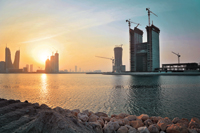
Bahrain Bay ... home to key new hotel projects.
Firmly focused
Bahrain is beating all odds to keep the economy afloat after last year’s crippling civil unrest. The government has put in place a viable stimulus package worth billions of dollars that is steadily driving the economy towards recovery.
01 January 2013
Despite the untold damage that the civil unrest is causing to the economic and social fabric of the country, Bahrain has been striding slowly but surely towards growth, purposefully pursuing the urgent development programmes on its agenda.
Among the priority projects on its growth plan is social housing, which is the watchword for this year and possibly for at least the next five years as Bahrain tackles head-on its acute housing shortage that has been a sore point with the local populace for well over a decade now.
And despite the political scenario, the country has retained global confidence as is evident from the international and regional hospitality chains that are expected to open in the next two to three years. At Bahrain Bay alone, a $2.5-billion masterplanned waterfront community in the heart of Manama, three hotels – the Four Seasons, JW Marriott Manama and Wyndham Grand Manama – are under construction (see Page 56), while in Seef, the Dubai-headquartered Ramee Group is putting the finishing touches to its first five-star property, the Ramee Grand Hotel and Spa, which will be the tallest hotel tower in the country when it opens by March (see boxed item).
In line with its goal of meeting its housing requirements, Bahrain is to build thousands of homes over the next five years, worth a staggering BD2.1 billion ($5.6 billion), funded primarily by the $10-billion GCC Marshall Plan, as well as a Kuwait fund and private investors. The government will allocate 46 per cent of the GCC financial lifeline to fund housing projects, in a bid to bring the waiting period for housing applications from citizens to under five years by 2016.
Under the five-year strategy, 47,000 units will be built through alternative housing programmes in partnership with the private sector, in addition to the hundreds of housing units that are already under construction.
The country’s economic growth gained momentum in the third quarter of 2012 after shrinking in April-June and is expected to recover further from the impact of social unrest, the state-run Bahrain News Agency (BNA) said. Its new two-year budget is expected help meet the basic needs of citizens and raise living standards, while keeping the financial sector stable and improving the investment environment.
In line with the country’s growth plans, the Ministry of Works is pushing ahead with the expansion of Bahrain’s road network as well as a range of special projects. One such project that was opened on schedule in November is the BD19.1-million ($50.6 million) National Amphitheatre, the third largest of its kind in the Arab world, after the Cairo Opera House in Egypt and Al Sultania Opera in Oman. The 1,001-seat amphitheatre on the waterfront next to Bahrain National Museum was commissioned by the Culture Ministry as part of celebrations marking Manama as the 2012 Arab Capital of Culture (see Page 63).
Among other key projects that are expected to be implemented this year is the expansion of Bahrain International Airport’s (BIA) main passenger terminal building and the construction of a major service centre. The airport capacity will expand to 13.5 million passengers per year from the current nine million passengers (see Regional News).
Roads
Among the key road projects, work is well under way on the BD98-million ($259 million) North Manama Causeway, which includes upgrading the junctions that connect the Al Fateh Highway to the King Faisal Highway and the Shaikh Hamad Causeway. Belgium’s Six Construct and Bahrain’s Haji Hassan Group are involved in the construction of the project (see Page 63).
Another major ongoing road project is the BD25-million ($66.25 million) Mina Salman Interchange, where more than 400 people have been working round-the-clock to ensure work is completed on schedule by November this year. The project has reached 47 per cent completion. More than 74,000 vehicles, 24 per cent of which are heavy vehicles, pass through the junction daily and during peak hours the number of vehicles crossing the interchange reaches 8,000.
In line with Bahrain’s plans to replace its roundabouts with signalised junctions, work has now been completed ahead of schedule on a BD771,426 ($2.04 million) contract for the development of Shaikh Daij Road/Palace Road junction to ensure smooth traffic flow. The Electricity and Water Authority is also upgrading the water mains in the area as part of this project.
Another key contract completed last year was a BD1-million ($2.66 million) development project of Al Ghoos Road in Busaiteen. The road aims to improve traffic flow, increase road capacity, reduce congestion and enhance road safety.
Meanwhile, work on a new causeway that will provide direct access to the BD1-billion ($2.66 billion) Northern Town project from the Seef District, bypassing the Budaiya Highway, is now expected to start at the beginning of 2015, after almost a decade of delays.
Municipal councillor Hussain Al Sagheer said planners must await the results of two studies – one archaeological and the other on the environmental and agricultural impact – before deciding the final route. That means it could be early 2014 before designs for the highway are drawn up.
The two studies, which are now expected to be completed by end of this year, aim to minimise the impact of the new BD69-million ($182.8 million) causeway.
Among other delayed projects, the much-awaited BD1.1 billion ($3 billion) Friendship Causeway project linking Bahrain and Qatar continues to be hampered by the escalating costs. The project, nevertheless, is anticipated to see completion in time for the 2022 Fifa World Cup hosted by Qatar. According to Bahrain’s Foreign Minister Shaikh Khalid bin Ahmed Al Khalifa, Qatar has confirmed the causeway as part of the development projects in preparation for the World Cup.
Housing
Northern Town, East Hidd and Buhair Valley are currently the major areas of focus for housing projects to meet Bahrain’s housing needs. Reclamation work at a site in East Hidd for a massive housing project was completed last November under a package costing BD24.4 million ($64.34 million). Bids are expected to be invited this month to build 1,500 homes as part of the first phase. The development will comprise 4,500 to 5,000 housing units capable of accommodating more than 30,000 people on 227 hectares.
Meanwhile, some 530 homes are to be built as part of the first phase of the Northern Town project. Four Bahraini contractors have been selected to build the homes, which are expected to be ready in one year.
The city will include about 15,000 homes, with the first phase comprising 2,300 homes that will be built in two-and-a-half years. The first phase will also include 2,470 homes to be built by the real estate and infrastructure development company Naseej.
Early last year, the Housing Ministry signed a landmark public private partnership (PPP) agreement worth BD208 million ($550 million) with Naseej to help construct 4,100 housing units in three years including the Northern Town, Al Buhair and Al Lawzi.
The deal is believed to be the first of its kind in the Gulf and hopes to help tackle the nationwide housing shortages.
“This agreement is considered the biggest of its kind in the ministry’s history in terms of the number of housing units to be built in partnership with the private sector, as part of a series of innovative solutions through which the ministry aims to reduce waiting lists,” said Housing Minister Bassem Al Hamer.
Meanwhile, the Ministry of Housing also intends to redevelop the existing housing facilities in various locations to maximise on the footprint of these sites. Mohammed Salahuddin Consulting Engineering Bureau (MSCEB) is the design consultant on the projects (see page 67).
Commercial & residential projects
While understandably projects have been stalled or have been making very little progress due to the political tensions, the prestigious Bahrain Bay has managed to attract interest and sustained growth over the past year. Among the major projects that have progressed at the development are the Four Seasons Bahrain Bay, the CIH tower (which houses the Wyndham Grand Manama), JW Marriott Manama and the Al Baraka Group headquarters.
Other landmark projects that have seen progress are the Diyar Al Muharraq, Dilmunia and Durrat Al Bahrain.
Diyar Al Muharraq, a private sector development off the coast of Muharraq that will comprise some 30,000 units, is expected to be home to a multi-million-dollar Dragon City, the 46,000-sq-m first phase of which is targeted to be operational by the third quarter of 2014.
The concept of the Dragon City, which will boast Chinese-style architecture and buildings, has been drawn up jointly by China Middle East Investment and Trade Promotion Centre (Chinamex) and Diyar Al Muharraq.
Diyar Al Muharraq comprises a mix of residential and commercial properties to accommodate more than 100,000 people. It will have extensive beaches spanning more than 40 km, modern facilities like schools, medical centres, parklands, sports facilities, shopping malls, showrooms, banks, and hotels.
Meanwhile, though tenders were announced early last year on the initial infrastructure phase of the $1.6-billion Dilmunia Health Island, no contract announcement has been made to date. Preliminary development of the 125-hectare island including dredging, reclamation and rock protection works, has already been completed. The artificial island, the first of its kind in the Middle East and North Africa region, is located off the northeast coast of Muharraq and will comprise residential, leisure and commercial sub-developments, surrounding core health and wellness facilities.
The tenders for the first of four infrastructure development phases encompass work relating to the island’s highways, bridges, landscaping and its power, potable water, sewerage and drainage and telecommunications networks. Phase One is expected to take 24 months to complete, but will enable the completion of various sub-developments within the same time frame.
The contractor will work closely with infrastructure designer Mott MacDonald and cost consultant DG Jones and Partners to deliver this landmark project, which is expected to turn Bahrain into a world-class health tourism destination.
Phases Two, Three and Four will see the completion of the 2.2-km Grand Canal and other infrastructure work for the remainder of the development.
Among other developers, Manara Developments said it has completed the bulk of the work at its ambitious housing project Wahat Al Muharraq, while progress is also being made on its other projects.
The Bahrain-based real estate development company started work on the construction of the second phase of the BD18-million ($47.4 million) Wahat Al Muharraq last August. Phase Two of the project comprises 180 villas while the first phase comprises 47 villas.
Manara is currently involved in three projects aimed at middle- to limited-income earners in several locations across the kingdom including Phase One of Janayin Al Hamala comprising 148 villas, and the second phase of Tubli Gardens, which consists of 27 villas.
Meanwhile, plans have been announced for a BD40-million ($104.64 million) sports city, which will feature a sports dome, an outdoor pitch, mini-soccer hall, squash court and a climbing area, a report said.
Named The Ball Park, the state-of-the-art private development will also include a women-only yoga garden, swimming pools, gyms, aerobics studios and a clubhouse. The proposal, which has been approved by the Northern Municipal Council, also calls for an open-air shopping complex, art galleries and food-court at the city.
The land earmarked for the project was initially meant to accommodate a 150-private villa scheme, which was approved by the council in 2009.
Other key developments announced include a BD24-million ($63.8 million) “miniature Disneyland” project in Muharraq. A deal has been signed by local investor Fouad Shuwaitar to enable work to start on the massive project, which will see the overhaul of the Grand Muharraq Garden more than two years after councillors scrapped it.
The spectacular theme park featuring a variety of rides, landscaping and the country’s longest walkway at 1,550 m will be operated by the investor for 25 years.
Industry
The Bahrain International Investment Park at Hidd and the proposed new Industrial City project will go a long way in furthering Bahrain’s ambitions in the industrial sector in line with the nation’s efforts to attract international investment.
Meanwhile, its industrial giants have expansion plans of their own. Aluminium Bahrain (Alba), the fourth largest aluminium smelters in the world which has fuelled the growth of a robust downstream aluminium industrial sector in the country, intends to set up its sixth potline and has appointed Bechtel Canada to perform a bankable feasibility study (BFS) for its expansion project. The study will include the economic analysis for the construction of the new Line Six and Power Station Five. The line is expected to increase Alba’s production capabilities by 400,000 tonnes annually. The smelter currently produces 881,000 tonnes per year of aluminium.
In the hydrocarbons sector, Bahrain Petroleum Company (Bapco) is planning to award a front-end engineering and design contract shortly to expand its only refinery in Bahrain. The expansion, expected to be completed in 2018, will help increase the refinery’s capacity to more than 450,000 barrels a day from 260,000 barrels at a cost ranging from $6 billion to $10 billion.
Among other key developments in the industrial sector, Bahrain-based United Steel Company (Sulb) is developing a major steel plant in the Hidd Industrial Area, and signed a number of loan agreements last year with leading banks to help finance it.
The Sulb project involves a total investment of $1.4 billion including the acquisition of Saudi Sulb, a steel company operating from Jubail in the Eastern Province of Saudi Arabia.
The loans will help Sulb complete its facilities including a direct reduction iron plant with a nameplate capacity of 1.5 million tonnes per year (tpy), a melt shop with a capacity of 1 million tpy and two rolling mills with a total capacity of 1.2 million tpy for the production of light, medium and heavy sections and beams. The facility is expected to start operations in the first-quarter of 2013.
In its second phase, a melt shop with an additional nameplate capacity of 1 million tpy and a rebar mill with annual capacity of 600,000 tonnes are planned.
Sulb is a joint venture between Bahrain-based Foulath (51 per cent) and Japan’s Yamato Kogyo Company, a leading sections and beams producer. The Sulb plant is being established within Foulath’s existing 1.3-million-sq-m state-of-the-art steel production complex, adjacent to Gulf Industrial Investment Company’s (GIIC) pelletising plants and Sulb’s cold-rolled stainless steel mill, both wholly-owned subsidiaries of Foulath.
Sulb is being built by two world-class consortiums, the first being Kobelco of Japan and Midrex of the US and the second being Germany’s SMS Meer and SMS Concast and Korea’s Samsung.
Sustainability
Bahrain has been spearheading a drive towards sustainable construction. One such pioneering project in the region is a smart solar grid in Awali that is expected pave the way for future smart cities in the region. Bahrain’s National Oil and Gas Authority (Noga) is installing 5 MW of solar capacity, which will be linked into a wireless smart grid network in co-operation with Petra Solar, Bapco and Caspian Energy Holdings. The grid circumvents common interconnection issues and costs of traditional solar systems because of its ability to install into the current transmission and distribution infrastructure. Bahrain intends to spread similar sustainable technology across the country in the future.
The state is also expected to launch the construction of its first “green town”, plans for which were unveiled recently. Blueprints for the 356-hectare project include government houses, schools, a library, a theatre, a health centre, natural sanctuaries, a botanical garden and public parks, in addition to luxurious villas and eco-friendly commercial and office buildings.
In addition, Bahrain is looking at implementing laws that will pave the way for constructing green buildings across the country. The Central Municipal Council has become the first council to approve the draft for new legislation that looks at reducing all types of pollution and increasing green zones and plantations. The new legislation will require owners of new buildings to adhere to international environmental standards that cover lighting, noise, air-conditioning, ventilation, heating, building materials, electricity, pavement and emissions.
Under the new requirements to be implemented this year, buildings must include 50 per cent greenery of their total land space, including planting of palm trees and local vegetation. At least, 50 per cent of each facility’s rooftop must also have a green zone.
- Firmly focused
- Tallest hotel to open doors soon
- Bahrain projects at a glance
- Bay watch
- Milestones met
- MSCEB delivers world-class projects
- School’s new campus gets finishing touches
- Glasstech sets sights on export arena
- Business shapes up well for Paschal
- BASF opens biggest CSB plant in country
- VK Universal takes on industrial role
- AMA restructures unit to take on challenge
- Kobaisi brings dream homes within reach
- Kobaisi system meets ‘overwhelming’ response
- Keller celebrates four decades of service
- Test
