

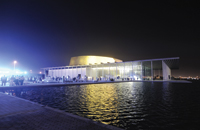
The National Amphitheatre ... in line with Vision 2030.
Milestones met
01 January 2013
Last November saw the completion on schedule of the showpiece National Amphitheatre at a cost of BD19 million ($50.39 million) – concrete evidence of the drive and determination of Bahrain’s Ministry of Works (MoW) to get things done despite the civil unrest in the kingdom.
The theatre, which celebrates Bahrain as the 2012 Arab Capital for Culture, is the third largest of its kind in the Arab world after the Cairo Opera House in Egypt and Al Sultania Opera in Oman. Designed to international standards, it can accommodate 1,000 people and comprises a number of halls for various purposes.
The amphitheatre is one of several special projects that the ISO-certified MoW has initiated or completed over the past year in accordance with its strategic plan for 2014 in line with Bahrain’s Economic Vision 2030.
“Being a vital contributor to the development of Bahrain, the ministry is committed to providing high quality services to the people of Bahrain in order to provide a better life for all. The MoW contributes to the economic, social and cultural sectors in Bahrain, thus supporting the kingdom’s economy and enhancing partnerships with various parties,” says a spokesman for the ministry.
The ministry builds public infrastructure, working to shape the future through partnerships. Its scope of work includes planning, developing and maintaining roads and sewerage networks; developing and maintaining public buildings like schools and hospitals; managing strategic projects like transport and sports projects, in addition to reclamation works implemented by the government sector; inspecting and approving building materials and other quality related materials; and co-ordinating operational planning processes between the parties concerned with infrastructure projects, which is done through the Central Planning Office at the ministry.
Roads
Among the key road projects implemented in 2012 are:
• The four-lane King Faisal Detour Road, which carries traffic from east to west towards King Faisal Corniche. The King Faisal Highway has been expanded from six lanes to 10 lanes, transforming it into a highway that carries traffic from west to east. The BD5-million ($13.25 million) project also included increasing parking spaces along the corniche.
 |
King Faisal Highway expansion ... a major MoW project. |
• Ring Road connecting Bahrain Bay and Bahrain Financial Harbour: The works, which are now close to completion, make up Phases One and Two in the North Manama Causeway project, in addition to road works involved in the Bahrain Financial Harbour project. Phase One comprises a 51.5-m marine causeway, in addition to the road works stretching from the Bahrain Financial Harbour to the one-way causeway heading towards Bahrain Bay. Phase Two comprises a one-way 237-m causeway and a section located north of King Faisal Highway; and stretching from the one-way causeway to King Faisal Highway.
• Extension of Dry Dock Highway, Phase One: This project, which provides additional entrances to Northern Muharraq’s villages, namely Qalali, Samaheej and Al Dair, was completed in July 2012.
• Estiqlal Highway: The revamping of the section between Al Hikma Junction and Isa Town Gate Interchange forms the final phase of the upgrade of the highway. All improvements involved in the project are expected to increase the capacity of this vital highway and alleviate traffic congestions in this area.
• Palace Avenue Junction-Shaikh Duaij Avenue: This is the last in a string of projects designed to replace roundabouts in Manama with traffic signals. The project comprised replacing the roundabout with a traffic signal, reconstructing parts of Shaikh Duaij Avenue and Palace Avenue, in addition to constructing a rainwater drainage and lighting network and replacing a number of service networks.
The MoW’s Roads Upgrade Unit has also implemented several projects, some of which have been completed, such as the Shaikh Isa bin Salman Highway. Other projects under way include Shaikh Salman Highway (West Riffa-Awali), Shaikh Hamad Highway (Hamad Town), Al Mazaria Avenue (Jasra-Hamala) and King Hamad Highway (leading to Durrat Al Bahrain).
In addition, some 30 other road projects have been upgraded or newly constructed.
Meanwhile, the MoW has also been implementing the Villages Revamp Programme 2012, which has seen work completed on 19 villages with work currently in progress on 11 others. The programme covers 30 out of a total of 70 villages at a cost of BD28 million ($74.27 million).
Construction
In the special projects sector, in addition to the National Amphitheatre the ministry has also been the working on the Isa Town Sports City, which calls for a facelift and upgrade of the existing Bahrain National Stadium. The project is expected to boost the stadium’s capacity to host important sports events in the future.
Works include replacement of the stadium roof, installation of new spectator and VIP seats, enhancing the stadium’s lighting to suit the HD (high-definition) TV system, painting of lighting towers, and construction of a field, new toilets and canteens.
Also included in the scope of works is the paving of the VIP and spectator parking lot, in addition to constructing new roads and 1,300 new parking spaces. Works also entail improving current entrance and exit points and opening a new exit point on Muharraq Avenue.
 |
Hawar Jetty ... $6.63-million project. |
Other key projects completed by the ministry last year include:
• Hawar Jetty: The BD2.5-million ($6.63 million) project has the capacity to moor 20 vessels up to 90 ft long, and features deep water access and navigation markers. Marine works comprise construction of breakwaters to shelter the marina, a reclamation platform for buildings, harbour basin and access channel dredged to -3.5 m chart datum, and navigation marks in accordance with GOP (General Organisation of Ports) requirements.
The project also includes pontoon works as well as construction of a building located next to the marina on the reclaimed land for the Coastguard and a harbourmaster.
• Revamping of Bahrain Training Institute (academic building): Work on the three-storey academic building, which covers an area of 16,170 sq m, is now close to completion at a cost of BD6.1 million ($16.2 million). The building includes 45 classrooms, 33 laboratories, administrative and academic offices as well other facilities.
• Ghazi Al Qusaibi Secondary School, Hamad Town: The project, which covers an area of 10,308 sq m, was completed in October 2012 at a cost of BD2 million ($5.5 million).
• Halat Bu Maher Health Centre: Piling works for this project, one of the biggest of its kind in Muharraq, commenced in April 2012. The two-storey health centre, costing BD4.2 million ($11.14 million), will serve Muharraq residents.
The MoW has also carried out maintenance works at 42 government schools at a cost of BD2.5 million ($6.63 million) in preparation for the 2012-13 academic year.
Sanitary Engineering
Two key projects in this sector are an industrial sewage treatment plant (STP) and sewerage network for Al Ma’ameer industrial area, and the third dryer at Tubli effluent treatment plant.
 |
The Ghazi Al Qusaibi Secondary School, Hamad Town ... education focus. |
Phase One serves 500 properties and was initiated in December 2008 at a cost of BD8 million ($21.22 million). It involves a 24-km sewerage network with diameters ranging from 50 to 600 mm, a 19-km rainwater drainage network with diameters varying between 150 to 800 mm, eight pumping stations, and construction of a 13-km road network.
Phase Two includes construction of the Ma’ameer STP at a cost of BD6.4 million ($16.97 million). The STP, which will utilise MBR (membrane bioreactor) technology, is the first of its kind in Bahrain. It will not emit odours and have no environmental impact, and the treated water will be suitable for irrigation and industrial uses. The plant’s capacity is estimated to be 2,500 cu m per day, which can be increased to 3,800 cu m per day.
Meanwhile, the MoW is close to completing work on the sludge dryer factory at the Tubli plant, where a third sludge dryer unit has been installed. The BD2.7-million ($7.16 million) project will contribute effectively to reducing foul emissions.
- Firmly focused
- Tallest hotel to open doors soon
- Bahrain projects at a glance
- Bay watch
- Milestones met
- MSCEB delivers world-class projects
- School’s new campus gets finishing touches
- Glasstech sets sights on export arena
- Business shapes up well for Paschal
- BASF opens biggest CSB plant in country
- VK Universal takes on industrial role
- AMA restructures unit to take on challenge
- Kobaisi brings dream homes within reach
- Kobaisi system meets ‘overwhelming’ response
- Keller celebrates four decades of service
- Test
