

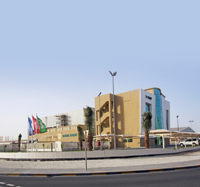
BASF‘s CSB facility ... the largest in the country.
BASF opens biggest CSB plant in country
01 January 2013
BASF, the largest diversified chemical company in the world, has substantially boosted its presence in the Middle East by opening a state-of-the-art plant for customer specific antioxidant blends (CSB) – the company’s largest facility of its kind – in Bahrain.
CSBs are key additives for the production of polymers for the plastics industry. They increase the thermal stability of polymeric materials. Antioxidants prevent oxidation which degrades the colour, appearance and performance of plastics.
“The plant will produce a wide range of plastic additives which will be mainly supplied to the GCC,” says Frank Fasdernes, BASF business management director, plastic additives, Eastern Europe, Africa and Western Asia. “This facility will be well positioned to serve the fast-growing polymer market in the Middle East with a special focus on key customers in the GCC, one of the fastest growing regions for the production of polyolefin resins worldwide.”
He continues: “We are very happy to establish a state-of-the-art CSB production site close to our customers in this fast growing region. This is backed by our powerful production network of antioxidants in Asia, Europe and the Americas, making us one of the leading partners to the plastic processing industry worldwide with a product portfolio unmatched in terms of diversity and quality. BASF is very much committed to further strengthen its plastic additives business ranging from antioxidants and light stabilisers to pigments.”
 |
Dr Hassan Fakhro, Bahrain’s Minister of Industry and Commerce (third from left) and Sabine Taufmann, German ambassador to Bahrain (fourth from left) with BASF officials. |
“The expected growth of the plastic polymer production in the Middle East will get an additional push by increasing efforts to grow the plastics downstream market locally. We will top up such growth with technical solutions and flexible supply patterns which are only possible as a local supplier,” he says. “It will also help us to deliver high quality products tailor made to the demand of the industry. Furthermore, the proximity to our main customers will ensure a flexible and reliable supply.”
The decision to set up a facility with a sizeable capacity in Bahrain was taken in response to demand from the region. This new plant has come in addition to the existing manufacturing agreement for CSBs with Astra Polymer in Saudi Arabia, making BASF the largest CSB supplier in this region, he adds.
The plant in Saudi Arabia has been running successfully over several years. “Since we have a very strong increase in demand, we decided to add another capacity in Bahrain. But the technology here is different,” he explains. “It is the latest patented technology of BASF that we have brought here.”
Construction of the new plastics additives blending plant was launched in September 2011 over a 15,000-sq-m greenfield site. The development included construction of two production lines housed in a factory and a central operation building. The two lines will provide flexibility of production. Construction work was carried out by Bahraini companies while the equipment parts came from Europe.
The fully-automated plant incorporates the latest technologies of BASF. The project also included construction of associated infrastructure and utilities. The entire plant complies with modern environmental standards.
The facility’s production portfolio includes antioxidants, effect pigments, organic and inorganic pigments, process stabilisers, ultraviolet light stabilisers and other additives. It will start with 60 to 70 per cent capacity utilisation and eventually ramp up as demand increases, he says.
“The main raw materials will be sourced from our own antioxidant production in Asia and Europe. These will form the core of our CSBs. We would also use third-party materials which are specified and qualified by our customers in Asia, Europe and the US,” he adds.
The facility will be the most economical and qualitative as regards technology, Fasdernes says. “We know the quality we need to produce and can produce all forms that are required, giving us the flexibility to respond to customer demand. Definitely, our latest technology will ensure that we advance into a new generation of production. In short, it will be the most automated plant,” he says.
The plant has been designed to cater for expansion. “We will look into all possibilities, but it is too early to comment on Phase Two expansion. However, we see robust growth,” he says.
Regarding marketing, he says the plant was built to cater to the GCC countries, but there are possibilities to grow into the Commonwealth of Independent States (CIS) and African markets.
“We see that the demand we are forecasting will ensure high utilisation at the plant. We are already thinking ahead and are very confident that it was the right choice here and be now stronger. We were already a local supplier and producer but with this plant we can cater to the other GCC countries.
“Our target markets are mainly Saudi Arabia and the UAE followed by Qatar, Kuwait and Oman. In terms of sales, we will be able to grow slightly above the market, which is actually difficult considering our already high market share. With the wide range of products and technology at our disposal, we have a very good base to grow,” he says.
“For distribution, we are setting up an integrated production hub for the Middle East. The distribution network will use the BASF network, which has its own trained people to look after it. CSBs are tailor-made products on customer recipes and you have much more flexibility in supply if your production base is close by.”
The plant has the highest standards of safety. Its ISO certification will take place this month (January).
Regarding environmental standards at the plant, Harald Kroll, managing director of BASF UAE, says the plant uses a process that will have no waste gas or waste water. No solid waste will go to the landfills. All of that will be sent back to the suppliers or incineration plants outside Bahrain.
“For a start, the facility will employ 70 per cent Bahrainis. We have had excellent cooperation from Tamkeen and the Economic Development Board. The local employees have been sent to Europe for training,” says Kroll.
Asked why BASF chose Bahrain to set up the plant, he says: “Bahrain has provided us all the parameters we were looking for including favourable geographical location and infrastructure, good business climate and competent labour.”
- Firmly focused
- Tallest hotel to open doors soon
- Bahrain projects at a glance
- Bay watch
- Milestones met
- MSCEB delivers world-class projects
- School’s new campus gets finishing touches
- Glasstech sets sights on export arena
- Business shapes up well for Paschal
- BASF opens biggest CSB plant in country
- VK Universal takes on industrial role
- AMA restructures unit to take on challenge
- Kobaisi brings dream homes within reach
- Kobaisi system meets ‘overwhelming’ response
- Keller celebrates four decades of service
- Test
