

Colossal challenge
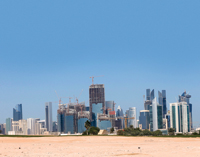
Ambitions run high in Qatar as it pursues its Vision 2030 and gears up to host the 2022 Fifa World Cup. Given the time frame for completion of its estimated $150-billion infrastructural aspirations, the nation now needs to press ahead despite the warnings of rising costs and limited resources.
01 March 2013
INFRASTRUCTURE is in the limelight as Qatar sets in motion its ambitious plan to put in place the world-class facilities expected of a host nation of the prestigious 2022 Fifa World Cup. In doing this, it will be constructing state-of-the-art stadiums, roads, railways and metros that will transform the country into a global destination for sports and business.
Now with the opening of the nation’s showpiece airport – newly renamed as Hamad International Airport – next month, Qatar will have crossed the first milestone towards its goal that will have an estimated price tag of a whopping $140 billion to $150 billion.
Most of the big-ticket projects in the country are in the infrastructure sector with the largest being its integrated transport network which is estimated to cost a staggering $37 billion. Mega projects that have already been launched include the $45-billion Lusail City, $5.49-billion Msheireb Downtown Doha, the world’s first sustainable regeneration of a downtown area, the $7.4-billion New Doha Port, the $1.5-billion Doha Convention Tower, the $2-billion Waab City, the $1.6-billion Doha Festival City, new-build and upgrade of existing sports stadiums worth some $4 billion, and a $27-billion roads programme including highway projects such as the $8-billion Doha Expressway.
According to a Business Monitor International (BMI) report, Qatar will spend a mammoth $150 billion in construction and energy projects to support its Vision 2030 and the 2022 Fifa World Cup programme. The country’s infrastructure sector will undergo major changes in the run-up to the World Cup, with top international players and local contractors through foreign partnerships, standing to benefit, says the report. It also points out that due to long lead-times, the majority of awarded projects have yet to take off, meaning the impact will not be notable on the construction sector growth until 2013, and only make a considerable impact by 2016 and beyond.
 |
|
The Doha Convention Centre Tower ... relounched. |
The massive volume of work that needs to be done is incomparable on a global scale, given the size of the country and the time frame that it needs to be done within. The pressure is already mounting to secure the expertise as well as the human resources required to build the infrastructure required – for which the country intends to spend an average of over 10 per cent of its national output annually, according to Reuters.
As it presses on with its flagship projects, Qatar is seeing significantly higher construction costs. According to the Tender Price Index for Qatar, prepared by Meed Cost Indices, construction costs in 2017 will be 18 per cent higher than current price levels. The rise in costs will put a strain on Qatar’s supply chain and will ultimately have an impact on the value of contract awards from 2013 onwards, reaching a peak of $40 billion in 2017.
The country, nevertheless, enjoys sound economic fundamentals and is reaping the rewards of having pumped in billions of dollars in developing its hydrocarbons sector.
As the world’s richest nation per capita and the top liquefied natural gas (LNG) exporter, Qatar has the wherewithal to support its formidable infrastructure ambition. According to the General Secretariat for Development Planning forecasts Qatar’s non-hydrocarbon economy – expanding by 9.6 per cent in 2013 – will spearhead overall growth and show a marginal gain from the forecast made in June’s Qatar Economic Outlook (QEO) 2012–2013. Its growth will help to push real gross domestic product (GDP) to 4.8 per cent from June’s forecast 4.5 per cent. In 2013, construction activity is expected to ratchet up some more and expand at a double-digit pace, it said.
Additionally, a widely anticipated law to regulate public-private partnerships (PPP) will accelerate development of key infrastructure projects, with the Qatari government recognising the opportunities in engaging in private sector enterprise and the speed at which projects could potentially be completed – a process that could save the country some $30 billion, according to a 2012 study by Markab Advisory.
Airport
The initial phase of Hamad International Airport in Doha – which was earlier scheduled for launch last December – is expected to open on April 1. As part of the first phase of the $15.5-billion project, 12 international passenger airlines will begin operations at the transport hub. The new airport will serve 30 million passengers per year and handle 1.4 million tonnes of cargo per year, and will eventually be part of the mega HIA Airport City, which is expected to accommodate some 200,000 people (see Page 54).
Stadiums
Qatar will soon start the construction of the country’s first new football stadium for the 2022 Fifa World Cup, the Peninsula has reported. The 80,000-seater Lusail Stadium, which will host the tournament’s opening and final matches, is expected to be completed in 2015.
 |
|
Hamad International Airport ... to launch commercial operations next month. |
The stadium programme, costing $4 billion, comprises eight other world-class facilities including Al Wakrah, Al Khor, Education City, Sports City, Al Shamal, Doha Port, Qatar University, and Umm Sal stadiums. The existing Al Rayyan, Al Gharafa, and Khalifa stadiums are being upgraded.
In another development, Croatian companies have secured a project worth in excess of $130 million to build an indoor sports stadium that will host the World Handball Championships in Qatar in 2015 – marking the debut of the event in a Middle Eastern country. The 15,000-spectator stadium, described as one of the most advanced handball complexes ever built, will occupy a 44,233 sq m area in Al Ahli Sports Village.
Roads & Railway
Qatar has one of the GCC’s busiest road markets to date, with contracts valued $1.8 billion awarded last year, including a $640-million deal awarded to the UAE’s Al Jaber Group for Package 13 on the Doha Expressway and a $961-million deal to South Korea’s Hyundai Engineering and Construction for the 12-km Lusail Expressway, which will connect Doha to Lusail City.
The Doha Expressway network will consist of 280 km of four-lane dual carriageway. The country is also building a 7.5-km highway linking Doha and Dukhan.
Qatar Railways Company (QRC) last year awarded five contracts worth QR1.48 billon ($406.5 million) to start the first phase of the country’s integrated railway project, which will involve construction of a metro system within Doha, a long-distance passenger network and a freight transport network.
Work on the first phase will include a new 129-km track, featuring Red, Green and Gold lines that will link Al Khor in the north to Al Wakrah and Messaieed in the south.
Phase 1a, scheduled to begin construction shortly, will include four lines stretching across 75 km with 26 stations, as well as 56 km of underground lines in single-bore tunnels, 17 km on viaduct and 5.3 km at grade.
The rail project comprises more than 50 stations over its route with the first phase due to be operational by the end of 2019 and the second phase of construction expected to begin shortly after. Phase Two will include a 150-km high-speed line to Bahrain which will be integrated with the much-awaited BD1.1 billion ($3 billion) Friendship Causeway. The latter project continues to be hampered by the escalating costs but is anticipated to see completion in time for the 2022 Fifa World Cup.
QRC is also managing Lusail City’s light-rail transit system, which is expected to be open in August 2016.
Commercial & residential
To cater to the needs of a growing population, the rapid influx of foreign workers, and the much-awaited World Cup event, the public and private sectors are building as well as redeveloping vast cities, commercial complexes, hotels and residential facilities.
Notable among these are the Msheireb Downtown Doha, Lusail City, Doha Convention Centre and Tower, Doha Festival City, Al Waab City, and Golf City.
Msheireb Downtown Doha, considered to be the world’s first sustainable regeneration of a downtown area in a major city, has made significant progress over the past year in Doha with most of the enabling works completed and key contracts for the main construction works on the first two phases now under way. The QR20-billion ($5.49 billion) development will be delivered in five phases (see Page 60).
Work is also under way on the $1.37-billion Doha Festival City, a mixed-use iconic destination that will feature an entertainment and leisure complex, automotive showrooms and international hotels and a convention centre. The development is located just north of downtown Doha on Al Shamal Road, one of the main arterial routes to the city centre, which will connect Doha with Bahrain via the proposed Friendship Causeway. The 433,847-sq-m project broke ground in October 2011 and is slated for completion by Q4 2014.
Meanwhile, Lusail Real Estate Development Company (LREDC) has relaunched its Doha Convention Centre Tower project after a lapse of more than two years. Prequalifiers have submitted bids for the 112-storey project last December. Located in the West Bay Area, the building comprises a 400-m-tall concrete structure plus 150-m steel helix structure sheathed in a glass façade. It will have a host of hotel facilities and apartments, in addition to retail spaces. Work on the project was earlier halted following fears that it could disrupt the take-off and landing of flights in Doha.
Barwa Real Estate, one of Qatar’s leading real estate and investment companies, has been spearheading the development of a number of projects including the Barwa Financial District, Barwa Commercial Avenue, Barwa Al Sadd, Barwa Village and Barwa Al Khor, among others.
Construction work on the QR7-billion ($1.9 billion) Barwa Commercial Avenue is close to completion with the first components of the massive development now being handed over to tenants for their fit-out. The iconic mixed-use development stretches over an impressive 8.5 km in length in Doha, making it one of the longest single project developments in the world (see Page 64).
Barwa now plans to launch a QR18-billion ($4.94 billion) mixed-use Golf City project within Lusail City to include 4,000 residential units and a golf course, for completion by 2018.
Lusail City, one of the Gulf’s largest real estate developments, is targeted for completion in 2020. Covering 38 sq km to accommodate up to 200,000 people, it will contain residential areas, commercial districts including the $275-million Marina Mall, 22 hotels, four islands and two golf courses, in addition to the Lusail Stadium.
Meanwhile, Wa’ab City, one of the largest privately-owned real estate developments in Qatar, has relaunched construction works for both Nour Al Wa’ab and Janayin Al Wa’ab Villas. Main contractor Arabtec resumed full construction work last November. Al Wa’ab City expects to deliver the first set of fully fitted villas by July.
Nour Al Waab Villa project comprises 92 villas, each covering an area of 850 sq m. Janayin Al Wa’ab Villas will consist of 181 distinct four-bedroom villas, which will be built on an area of 450 sq m each. Al Wa’ab City is planning to complete the delivery of the 273 villas within two years along with all recreational amenities.
- Colossal challenge
- Qatar Project at a glance
- Ready for take-off
- Spearheading sustainability
- Business belt
- Danube opens second showroom in Doha
- Algeco sees good business for 4000KD unit series
