

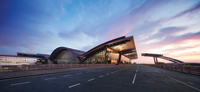
The passenger terminal of Hamad International Airport ... sprawling.
Ready for take-off
01 March 2013
QATAR’S new multi-billion-dollar Hamad International Airport (HIA) is poised to open its doors nearly eight years after the showcase project was launched.
Previously known as the New Doha International Airport, HIA was affected by a series of delays since it broke ground in January 2005, pushing the cost of building the hi-tech hub to in excess of $15 billion, according to Abdul Aziz Al Noaimi, chairman of Qatar Civil Aviation Authority and the new airport’s steering committee.
 |
|
A bird’s eye view of the new terminal. |
Now, HIA has been firmly placed on the flight path for start-up with a timeline that sees phased opening of services. This month will see the launch of cargo operations and on April 1, a dozen launch airlines are expected to fly in and out of this state-of-the-art airport, which itself is the precursor to a second terminal as well as a massive airport city, designed to accommodate some 200,000 people.
By the second half of this year, the national carrier Qatar Airways is expected to transfer its operations to its new home and some 30 million passengers will be able to experience travelling through the world’s newest aviation hub, says Al Noaimi.
During an exclusive preview of Hamad International Airport, Gulf Construction witnessed first-hand the sprawling passenger terminal complex with its wave-style roof rising above the horizon on what is still essentially a huge construction site that will house the future airport city.
 |
|
The terminal’s roof has a wave-like form with a transparent facade beneath. |
A stunning passenger terminal with a capacity of 30 million passengers per year and 25,000 sq m of retail and food and beverage facilities, two world-class runways – 4,850 m and 4,250 m respectively, built 2 km apart and reputed to be among the longest in the world – a state-of-the-art air traffic control tower, as well as a waterdrop-shaped mosque have all been completed. The overriding impression is a sense of space and light accentuated by the airport’s seafront location.
HIA will stretch across 10 sq km and apart from the multi-concourse Terminal One due to open shortly, it also includes an Emiri terminal, vehicle rental and car facilities, cargo, maintenance hangar and catering facilities.
 |
|
HIA’s passenger terminal ... 30-million passenger capacity. |
Placed at the edge of the Arabian Gulf less than 5 km from downtown Doha, Hamad International Airport’s waterside setting provides a perfect backdrop for its stylish architectural elements underpinned by leading edge technology. The departure area is located on the first floor in an impressive interior space with an undulating arched roof, echoing its idyllic location.
“Hamad International Airport goes beyond the definition of a traditional airport,” Al Noaimi says. “Its luxurious ambience is enhanced by resort-quality facilities; plush hotels, spas, swimming pools and leisure options like a squash court allow passengers to relax, refresh and rejuvenate themselves between flights. It is one of the few public spaces where people can enjoy a museum experience.”
Hand-picked ancient and contemporary art are showcased in a brilliant architectural setting within the departures concourse of the airport, following an agreement signed by the steering committee with the Qatar Museum Authority.
Hamad International Airport will redefine passenger and transit experience, making it truly world class and beyond expectations, according to Al Noaimi.
“Underpinning it all is the use of the most advanced airport systems internationally available today,” he says. “From environment-controlled terminal systems in the passenger terminals to advanced baggage handling processes and enhanced air traffic control systems with in-built fail-safe checks of location and identification of aircraft and vehicles on the airfield, HIA has heavily invested in leading-edge technology that catapults it into one of the most advanced airports in modern times.
“Technology takes centre stage at the cargo terminal, the catering facility and at the aircraft maintenance base to make these areas highly automated and state of the art.”
Construction
 |
|
One of two world-class runways at HIA. |
Land reclamation for the massive greenfield development that spreads over a 2,200-hectare site began in 2005. Some 50 per cent of the airport area has been reclaimed from the sea involving around 60.2 million cu m of fill. Site grading followed in 2006 and proved to be a complex process, said Bernardo Gogna, the project director.
A total of 47 contractors were engaged in some 100 contracts awarded to create this stunning landmark with the main construction consortium being Sky Oryx – a joint venture of Japan’s Taisei Corporation and Turkey’s TAV. The airport facility comprises more than 80 buildings of different sizes.
• Terminal One: Reflecting its seaside setting, the terminal’s roof has a wave-like form with a transparent façade beneath, which further emphasises the impact created by the curves.
Inside the 600,000-sq-m terminal, the design focus has been on the creation of a spacious, but efficient and convenient airport experience. The result is a multi-level building with arched columns, generous skylights and decorative finishes that enhance the feeling of space. The concourses will be comfortable, attractive and spacious, providing an oasis of amenities for waiting passengers.
The passenger terminal with 41 contact gates and remote gates is designed so that all passenger transfers can take place under one roof. With short walking distances between gates, and shorter connection times between flights, passenger waiting and walking times are minimised, all helping to ensure an effortless passenger experience within the facility.
 |
|
The state-of-the-art air traffic control tower at HIA. |
The terminal complex has 88 passenger loading bridges both for normal Code E aircraft and six positions for the A380. Fronted by a 29-hectare lagoon and the mosque plaza and landscape gardens, the complex also includes three central utility plants and a 3,450-slot car parking facility.
The departure hall is a 25,000-sq-m column-free space having 24-m-high ceilings. The departure concourses A&B – both identical – extend one kilometre from end to end and feature 20 gates with hold rooms, each comprising 270 seats.
Departure Concourse C is 700 m long and served by an automated people mover. Trains – which will be installed this month to be operational in the second half of this year – will operate in continuous shuttle between the North Node and South Node stations of the concourse.
• Air traffic control (ATC) tower: Resembling a pivot in the centre of the airport between the two parallel runways and airside facilities at HIA, the ATC tower is an elevated, triangular-shaped structure, topped by a circular glazed control room, about 90 m above the airport. Sitting at the base of the tower is a technical complex, comprising a series of buildings, rising up to four storeys high, which will house the advanced technical systems for the control tower.
• Emiri terminal: This 12,000-sq-m facility will provide an elegant gateway for the Royal Family, senior government officials and visiting dignitaries. Its design once again reflects HIA’s waterside setting. The exterior facades, made up of layers of longitudinally-curved walls with triangular sections, are reminiscent of high nautical sails. These radial layers of “sails” form the two-level spaces for the Emiri Majlis on the higher level, and the Minister Majlis and the VVIP lounges on the lower level in the terminal. The landside entrance to the terminal overlooks a spectacular lagoon with distinguished water features. On the airside, there will be a grand, ceremonial podium where guards-of-honour parades and ceremonies can be conducted. The terminal will have a capacity to handle five large aircraft including two Airbus A380 positions.
 |
|
The cargo terminal ... 1.4-million-tonne capacity. |
• Cargo terminal: This complex, made up of seven facilities covering more than 290,000 sq m in the midfield area, will have the capacity to process 1.4 million tonnes of cargo per year. The main feature of the complex is the 50,000-sq-m cargo terminal building, which houses the air cargo handling system. It also includes offices for the cargo terminal operator, government agencies such as customs, agriculture and health departments, airline representatives, as well as a 3,200-sq-m live animal centre.
• Aircraft maintenance hangar: This 150,000-sq-m base at the airport will be capable of holding eight wide-body aircraft simultaneously and a maximum 13 aircraft including the Airbus A380 (nose in or tail in).
The maintenance base is in the form of a large hangar for both line-base and heavy maintenance. The design of its layout and column-free spacing is focused on ensuring flexible aircraft parking at all times for maximum maintenance efficiency.
The workshop building to the rear of the aircraft hangar bays will provide specialised maintenance and automated spare parts storage. The central engineering office for Qatar Airways will be located adjacent to the hangar and workshops and will house the airline’s engineering departments including maintenance, quality assurance, material and engineering.
• Catering building: This 65,000-sq-m food operation and production area will have a capacity to produce 90,000 meals per day. The fully-automated in-flight and bulk kitchen catering facility, housed in a two-storey (plus basement) structure, will include a kitchen, freezing and chilled rooms, linen storage and laundry facilities, airside and landside food production, administrative and staff amenities, dish-washing and equipment cleaning facilities and airside-landside boundary checkpoints within the building. The facility will also include a simulation room to monitor/test the effects of heating meals at cabin pressure.
The statistics drawn up to create this massive aviation hub are staggering. At the peak of construction in 2011 some 50,000 workers were engaged on the project, including 900 engineering, project management, construction and cost control personnel. To date, the project has used some 87,600 tonnes of crushed rock, 2.3 million cu m of concrete, 2 million cu m of airfield asphalt, 140,000 tonnes of steel, 17 million linear m of electrical cable, 330,000 m of fibre-optic cable and 37,000 m of fuel pipes. The structures sit on some 8,900 concrete piles and are dressed in 86,000 sq m of curtain-walling. The piles for the terminal extend 20 m into the ground to support big architectural arches.
 |
|
Departure Concourse A ... extends one kilometre from end to end. |
All materials selected for the interiors – including metal panels, basalt stone, beautiful wood panels and terrazzo – are of the highest quality, sourced from the best places around the world.
Despite the current scale of the airport, provisions were made for future expansion of HIA and the infrastructure even before 2022 Fifa World Cup came into the equation. Now with Qatar hosting the World Cup, a non-negotiable date has been set for its final completion. Further phases of the airport – still under planning and construction – are scheduled for completion in 2020, well in time for the 2022 Fifa World Cup.
Future plans include a second terminal and rail station and additional apron parking required for the 2022 World Cup. Fifa has particularly stringent requirements regarding the number of planes that need to be parked at the same time, Gogna pointed out.
Once the second terminal is built, Terminal One will be used exclusively by Qatar Airways.
Phase B of expansion, which is due for completion by 2020, will see the airport’s handling capacity increase to 50 million passengers annually. Also to be developed in this phase are a back-up approach and training centre, expansion of Terminal One to include an apron extension as well as a railway station, Emiri flight facilities, North Cross taxiway, car rental facilities, additional hangars and cross taxiways.
As part of Phase 3B expansion, which is also due for completion by 2020, land reclamation works as well as the construction of Terminal Two, a railway station, plaza and the western taxiway and apron will be carried out.
Airport City
The operation of HIA will spearhead the development of the Airport City located between the new airport and Doha city. The masterplan of the proposed city is conceived as a series of four circular districts, connected by a ‘green’ spine, running parallel to HIA’s second runway. The clustered development seeks to create a strong visual identity – also from the air – and will comprise a business district, an aviation campus, a logistics district and a residential district adjacent to a newly-constructed marina.
In the first 10 years of the 30-year masterplan, substantial parts of the business district and all of the aviation campus will be developed. The aviation campus is traversed by a long podium – a symbolic entrance to Airport City and the location of the headquarters for Qatar Airways and the Civil Aviation Authority of Qatar. The business district is centered on a terminal complex, which will contain the second terminal for the airport and a train station for Doha, with metro and long distance rail links. The terminal’s plaza, connecting air and ground transportation, will be an intersection of the international with the local.
 |
|
The Emiri Terminal ... reminiscent of nautical sails. |
The four districts are unified along a north-south axis provided by the ‘green’ spine. Plans also include an air strip and airside facilities to support the western taxiway and apron parking (WT&AP) adjacent to HIA’s second runway.
The WT&AP system represents the next step in the development of the airfield facilities at HIA and provides a large expanse of additional apron area in the interest of both the short-term requirements of the Fifa World Cup and long-term airside development requirements.
The Terminal Two complex will be a multifunctional facility that will be a focal point of the business district and a catalyst for its development, attracting investment from local and international commercial sectors. It will also be a multimodal transport hub designed to connect air, rail, metro and bus services for use by domestic and international travellers. Commercial, business and hotel facilities located within the complex will form part of the overall economic sustainability strategy of HIA’s development for use by visitors to and residents of Qatar’s capital.
The three functional zones of the complex include the rail concourse and business centre; Terminal Two; and the event plaza, which will connect its facilities and the commercial functions, providing flexible space for informal gathering as well as planned events, notably those to be held during the 2022 Fifa World Cup.
- Colossal challenge
- Qatar Project at a glance
- Ready for take-off
- Spearheading sustainability
- Business belt
- Danube opens second showroom in Doha
- Algeco sees good business for 4000KD unit series
