

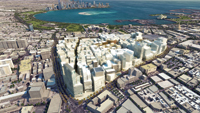
Msheireb Downtown ... the masterplan.
Spearheading sustainability
01 March 2013
MSHEIREB Downtown Doha, considered to be the world’s first sustainable regeneration of a downtown area in a major city, has made significant progress over the past year in Doha with most of the enabling works completed and key contracts for the main construction works on the first two phases now under way.
The QR20-billion ($5.49 billion) development, a signature project of Msheireb Properties – a leading real estate company and subsidiary of the Qatar Foundation for Education, Science and Community Development – broke ground in Doha in early 2010 and will be delivered in five phases.
 |
Msheireb ... blend of heritage and modernism. |
The 31-hectare Msheireb project site is immediately adjacent to the Amiri Diwan, Qatar’s seat of government and ruler’s palace. The site is also adjacent to the redeveloped Souk Waqif, a successful mixed-use scheme based on a traditional Qatari suq and the historical Al Koot Fort.
It will comprise commercial, residential and retail properties as well as buildings devoted to culture and entertainment. More than 100 buildings – between three and 30 storeys high – including 900 new residential units, and an estimated 11,000 underground parking spaces have been planned as part of the redevelopment project.
“The project aspires to be a template for other developments in Qatar, around the region and indeed the world – those that aim to be transformational in the way in which they respect the environment, preserve cultural traditions, and enhance the quality of life of local communities,” says a spokesman for Msheireb Properties.
 |
Diwan annexe in Phase 1A ... concept to completion. |
The development aims to blend traditional Qatari heritage and aesthetics with modern technology, and focus on sustainability and harmony with the environment. Simultaneously, it aims to address issues of congestion, sustainability, and maintaining the aesthetic and social individuality of Qatar.
On completion, Msheireb Downtown Doha is expected to accommodate up to 50,000 daily visitors within an area of 310,000 sq m.
The Msheireb project is partnering with a portfolio of world-class contractors and consultants while also prioritising opportunities for local companies, and sourcing materials and expertise locally as far as possible. In terms of the project’s hospitality offering, the developer has already signed agreements with the Mandarin Oriental Hotel Group and other hotel operators for hotel projects and serviced apartments within the landmark development. Accor also joined forces last April to develop and manage the first MGallery hotel in the region, which will be a distinctive boutique property offering a modern interpretation of Qatari heritage and hospitality.
Construction overview
The first phase, referred to as the Diwan Amiri Quarter, features three major government buildings, including the national archive, various heritage sites, a mosque, a museum, and the eid prayer ground. Subsequent phases will introduce the five-star Mandarin Oriental hotel, three additional hotels, high-end commercial office space, a variety of residential space, and a mix of shops and restaurants.
 |
Phase One is divided into Phase 1A and Phase 1B/C. The Diwan Amiri Quarter, heritage buildings, a mosque, amenities and infrastructure are part of Phase 1A, designs for all the major components of which are complete.
Following the completion of enabling works by Bauer, infrastructure works were awarded to CAT International in March 2010. Substructure works are currently in progress and are 99 per cent complete under a QR1.55 billion ($425.7 million) substructure and superstructure works contract awarded to a joint venture of Hyundai Engineering and Construction Company and HBK Contracting.
The main construction contract of the Heritage Quarter was awarded to Qatari Arabian Construction Company in August 2012.
The main building works on Phase 1A are 85 per cent complete and construction work has also commenced on the design-build contract for the district cooling plant.
To date, work on this phase has involved a total of 1,389,878 cu m of excavation, with 275,715 cu m of concrete poured and 85,612 cu m of stone installed. A total of 2,295 shoring piles and 726 working piles have been installed in the construction of the buildings. This apart, a 66-kV substation has also been energised.
Phase 1B/C comprises offices, townhouses, apartments, a hotel, civic buildings, a school, cultural centre, a mosque and amenities. Bauer was again engaged to undertake the enabling works, which were completed in March last year. Piling works awarded to Swissboring were also completed in March last year.
 |
Superstructure works on Phase 1B are currently been carried out by the Carillion-Qatar Building Company joint venture under a contract awarded in December 2011.
A joint venture of Brookfield Multiplex and Medgulf is responsible for substructure and superstructure works on Phase 1C under a QR1.5 billion ($411.96 million) contract awarded late last year. Phase 1C incorporates a total built-up area of 225,000 sq m, of which 122,000 sq m are in three levels of basement housing 1,200 parking spaces, logistic and plant areas, including district cooling and a 66 kV substation. Above grade, Phase 1C will have 10 buildings comprising four office blocks with 30 ground-level retail outlets, five residential buildings, 51 apartments and a primary school with a day-care centre.
To date, 1,648,105 cu m of excavation has been carried out, 1,619 piles installed, and 241,813 cu m concrete poured as part of work on this phase.
Phase Two, which is now under construction, comprises retail spaces, offices, apartments, cinemas, a department store, hotel and amenities. Arabtec was awarded the main construction contract on the project last November following the completion of design development on this phase.
Close to 93 per cent of the enabling works has been completed on this phase.
Phase Three comprises retail outlets, offices, apartments, daycare centre, hotels and amenities. Enabling works on this phase are complete and the contract for the raft foundation work was awarded to HBK Contracting last October.
Meanwhile, for Phase Four, HOK was appointed as lead consultant in April 2011 and design works are in progress. This phase comprises retail facilities, offices, apartments, community services, hotel and amenities.
Commenting on the outstanding features of this project, the spokesman says: “Msheireb Downtown Doha is the world’s first fully sustainable mixed-use downtown regeneration project. Msheireb Properties undertook three years of research with leading academics, architects and masterplanners to develop an architecture that is forward looking yet draws on the very rich Qatari architectural heritage. It is a new architectural language that respects Qatar’s heritage, environment and climate, while meeting and exceeding the social and cultural needs of Doha’s modern residents.”
 |
He emphasises that skills involved in developing a downtown area are very different from developing a greenfield site in that the existing infrastructure needs to be dealt with and existing buildings preserved and constructed around.
“Such projects require meticulous planning, development of new techniques and extensive interface with local authorities. We feel that the competencies we have developed while constructing this project as well as the extensive research process of devising a new architectural language and unique solutions for sustainability in a downtown environment makes us leaders in this field,” the spokesman adds.
Sustainability is at the core of development. The entire project is targeting Leadership in Energy and Environmental Design (Leed) Gold certification, with several buildings targeting Leed Platinum. “Msheireb will have one of the highest concentrations of Leed-certified sustainable buildings, thus making it the world’s first sustainable downtown regeneration project in the world,” says the spokesman.
Moreover, the development has already received ISO certification from the British Standards Institution for quality (ISO 9001:2008), environmental performance (ISO 14001:2004), and occupational health and safety (BS Ohsas 18001:2007).
- Colossal challenge
- Qatar Project at a glance
- Ready for take-off
- Spearheading sustainability
- Business belt
- Danube opens second showroom in Doha
- Algeco sees good business for 4000KD unit series
